History: from railway codes to the supermarket EAN
What a barcode is Basic concepts Lesson 2 of 14
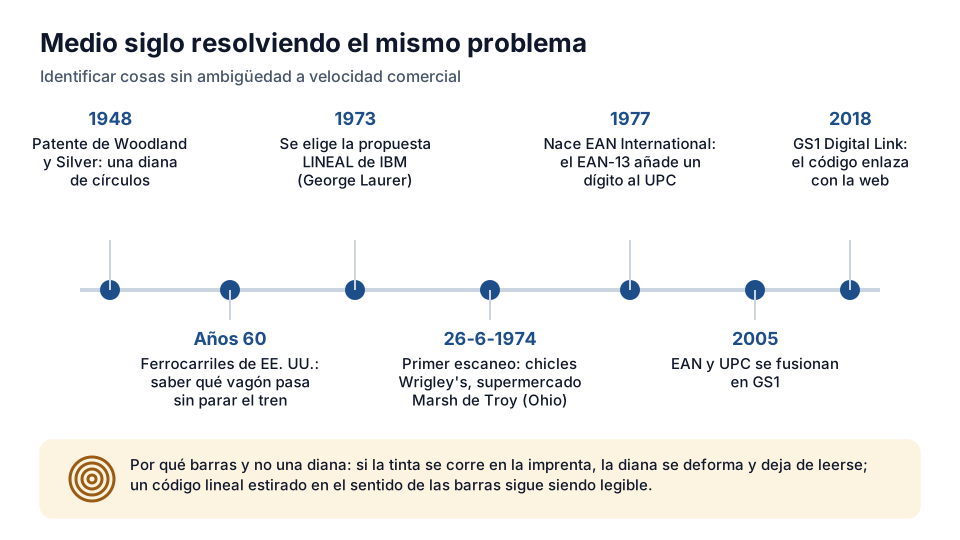
The first practical barcode identification system was born on the American railways in the 1960s: the companies needed to know which wagon was which without stopping the train. The idea of encoding data in bars of varying width had existed since 1948, when Norman Joseph Woodland and Bernard Silver patented an extension of Morse code printed in two-dimensional patterns — the same seed from which, decades later, 2D codes would grow.
The day that changed retail
The leap into retail came on 26 June 1974, at a Marsh supermarket in Troy, Ohio: a packet of Wrigley's Fruit Gum became the first product in history to be scanned at a checkout with a UPC-A. That packet is kept today at the Smithsonian. The bet was so big at the time that the supermarket installed twenty-seven scanners; the checkout where the first scan took place was called, with the humour of the time, “checkout number one of the future”.
A year later, Europe adapted the system by adding a digit for the national organisations: the EAN-13 (European Article Number) was born, which over the years was renamed International Article Number without changing the initials — and whose use is no longer European but worldwide.
From EAN to GS1
In 1977 EAN International was founded as the European sister of the UPC, and in 2005 both organisations merged into today's GS1. The name “EAN-13” survives in the sector's everyday language as a synonym for GTIN-13, but officially the symbology is called EAN/UPC and the identifier is the GTIN.
The lesson of this history for today's professional: the standard has spent half a century solving the same problem — identifying things unambiguously at commercial speed — and every layer added to it (logistics, variable data, web links) respects the original principle. That is why investing in understanding it well is an investment that doesn't expire.
Why bars and not a circle
Woodland and Silver's original patent wasn't for bars but for concentric circles, a kind of bullseye. It had a theoretical advantage — it can be read from any angle — and a fatal flaw for the printing presses of the day: if the ink smeared in the direction the paper travelled, the bullseye was distorted and could no longer be read, whereas a linear code distorted along the direction of the bars is still readable.
The committee that chose the supermarket standard in 1973 opted for IBM's linear proposal, developed by George Laurer. That decision, taken for reasons of industrial process rather than computing elegance, is why barcodes today are rectangles and not bullseyes. A good reminder that in this sector manufacturing constraints overrule theory.
What survives half a century later
Practically all of that design is still standing: the structure of fixed-width modules, the quiet zone, the check digit and the human readable interpretation underneath. What has changed is what has been hung around it: Application Identifiers for variable data in the 1980s, two-dimensional symbologies in the 1990s and the web link of Digital Link in 2018.
For today's professional this means that learning the basics well is not learning history. The EAN-13 you are studying will still be on packs when 2D is in the majority, because the migration of world trade is measured in decades and the coexistence of both symbologies is the planned scenario, not a short transition period.
Exercise
From history to the present
What is the main difference between UPC-A and EAN-13?
- UPC-A has 12 digits and EAN-13 has 13
- UPC-A is two-dimensional and EAN-13 is linear
- There is no difference: they are the same standard
Related lessons
Reading is free. When you sign up, you also:
- You save your progress and pick up where you left off
- You take the exams, marked straight away
- You receive a completion record, with your name, for each course you finish
- You ask and answer in the Community (in Spanish)
- You get the PRO level by adding your products
- With PRO, you unlock the advanced tools: labels, GS1-128 and SSCC
Unlock PRO tools and completion records Free. The team reviews every application.
Already have access?Mark this lesson as read in My academy
This lesson is part of the course Barcode and GTIN Fundamentals, from the Barcode and Traceability Academy.
This module includes the exam “Module 1 exam: Fundamentals”.
Next lesson What data a barcode encodes (and what it does not) 12 lessons left in the course