Barcode definition and purpose
What a barcode is Basic concepts Lesson 1 of 14
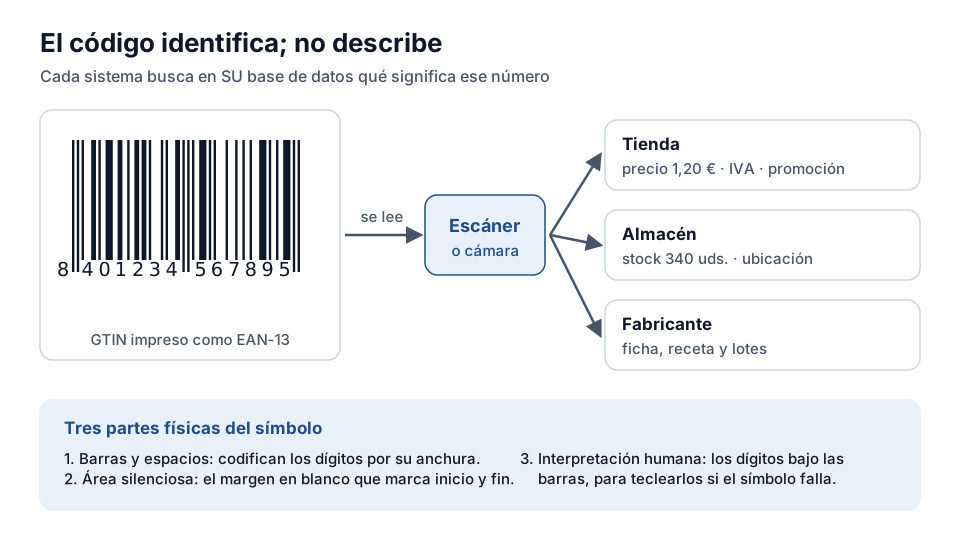
A barcode is a graphical representation of data that a machine can read optically. In commerce, it almost always encodes an identifier: the number that distinguishes one product from every other on the global market. The barcode doesn't describe the product — not its price, its weight or its composition — it only says which one it is, just as your ID number doesn't contain your name.
This separation between identifier and description is the key to the whole system: the same code works at the supermarket checkout, in the distributor's warehouse and in the manufacturer's records, because each system looks up in its own database what that identifier means to it.
What it is made of
Every barcode symbol has three physical elements: the bars and spaces (which encode the digits according to defined widths), the quiet zone (the mandatory blank margin that marks where reading starts and ends) and, in most cases, the human readable interpretation: the same digits printed underneath so that a person can key them in if the symbol fails.
The scanner doesn't read “an image”: it measures changes in reflectance with millimetre precision. That is why print quality is not aesthetic but functional, and why there are verification standards, which we will look at later.
Which standard is used in the real world
In international trade the dominant standard is that of GS1, the organisation that governs the product (GTIN), location (GLN) and logistic unit (SSCC) identifiers used by more than two million companies every day. When the checkout beeps in a European supermarket, behind it there is a GTIN printed as an EAN-13.
In this Academy we will always work with the GS1 standard: it is the one required by marketplaces, large retailers and sector regulations, and the one that makes a number issued in Spain valid in Japan.
What this course will give you
By the end of the course you will be able to read any GS1 label like a professional: what each digit is, why the check digit never fails, which symbology goes with each pack, how a symbol's quality is verified and which GTIN allocation mistakes end up costing product recalls. It is the foundation on which the Academy's other three courses rest.
Identifier, not attribute
The distinction between identifying and describing underpins everything else, and it is worth pinning it down from the start. The GTIN identifies; the weight, the ingredients, the allergen or the photograph are attributes, and they live in databases, not in the bars. When a manufacturer changes a product's recipe and wants the buyer to know, they don't touch the symbol: they update the attributes in their catalogue and, if the change affects what the consumer receives, allocate a new GTIN — a rule we will look at in detail in the lesson on allocation mistakes.
That architecture has an awkward practical consequence: the code does not guarantee the quality of the data. A perfectly printed EAN-13 can point to a record with the wrong weight. That is why the sector has built, on top of the identifier, mechanisms to synchronise data between manufacturer and retailer — GS1's GDSN is the most widespread — and why collaborative product databases state where each field comes from.
The three families of identifier
GS1 doesn't only identify products. The three keys that appear every day in any supply chain are the GTIN (the trade item: what is bought and sold), the GLN (the location: a factory, a warehouse, a loading dock or the company as a legal entity) and the SSCC (the specific logistic unit: this pallet, not “the pallets of this product”).
Mixing them up is costly. A delivery note that identifies the destination with a GTIN instead of a GLN cannot be automated; a despatch advice that identifies the pallet with the product's GTIN doesn't tell you exactly which pallet has arrived, which is precisely what you need on the day a batch has to be recalled.
Exercise
Check your understanding of barcodes
What is a barcode?
- A decorative label required on every product
- A machine-readable graphical representation of data, usually an encoded identifier
- A product quality certificate
What is the GTIN (Global Trade Item Number)?
- The manufacturer's trade name
- The unique global identifier of a product, defined by the GS1 standard
- Each shop's internal stock code
Related lessons
Reading is free. When you sign up, you also:
- You save your progress and pick up where you left off
- You take the exams, marked straight away
- You receive a completion record, with your name, for each course you finish
- You ask and answer in the Community (in Spanish)
- You get the PRO level by adding your products
- With PRO, you unlock the advanced tools: labels, GS1-128 and SSCC
Unlock PRO tools and completion records Free. The team reviews every application.
Already have access?Mark this lesson as read in My academy
This lesson is part of the course Barcode and GTIN Fundamentals, from the Barcode and Traceability Academy.
This module includes the exam “Module 1 exam: Fundamentals”.
Next lesson History: from railway codes to the supermarket EAN 13 lessons left in the course