What GS1 is and what it is for
The GS1 system Global identifiers Lesson 1 of 12
GS1 is the global not-for-profit organisation that defines and maintains the most widely used business identification standards in the world: GTINs for products, GLNs for locations, SSCCs for logistic units, Application Identifiers (AI) and the GDSN master data synchronisation system. It was born in 1977 as EAN in Europe, the sister of the American UPC, and today it operates through the GS1 organisations of more than a hundred countries — GS1 Spain among them.
The problem it solves
Its job is simple to state and hard to achieve: that a number issued in Spain means exactly the same to a scanner in Tokyo, an ERP in Germany and a marketplace in the United States. GS1 guarantees this with two mechanisms: it licenses the identifiers (none is duplicated because nobody invents them; they are obtained from GS1) and it publishes the allocation and usage rules that all members follow.
Without that global referee, each chain would have its own coding system and international trade would go back to conversion tables. The common standard is the invisible infrastructure of retail, food, healthcare and logistics.
What exactly it governs
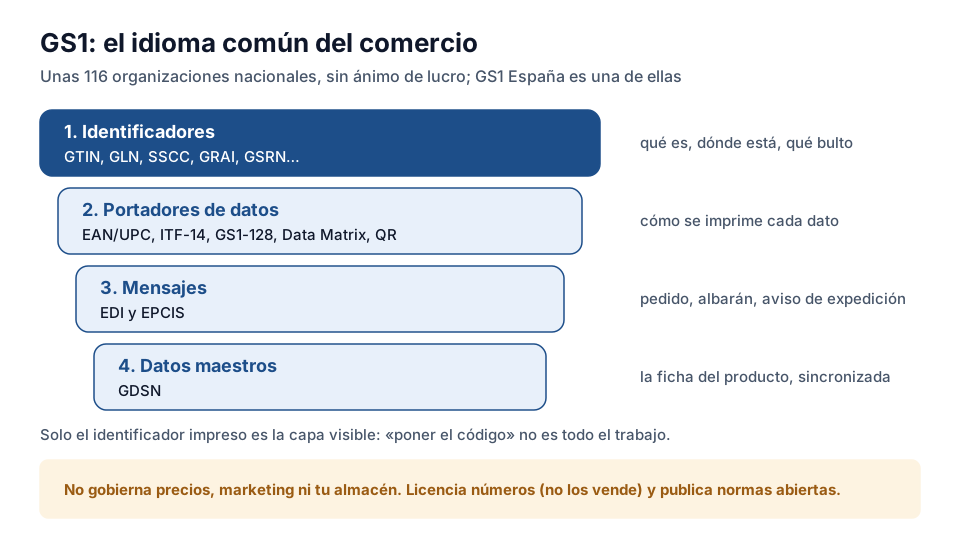
The identifiers (GTIN, GLN, SSCC, AI, and the ones you will see in traceability), the symbologies (EAN/UPC, ITF-14, Data Matrix, QR with GS1 Digital Link), the exchange messages (EDI in GS1 format) and the master data network (GDSN). It doesn't govern prices, or marketing, or how you run your warehouse: only identity and the language of exchange.
What it means for your company
That when you join you receive something no competitor can copy: a unique and permanent space in the global product catalogue. And that this space comes with obligations — using the numbers according to the rules, keeping up the fees, and not transferring the licence as if it were a brand. Marketplaces and large retailers check the GS1 origin of your GTINs: it is the first check Amazon makes when you list a product, and the first cause of rejected listings.
An organisation, not a company
GS1 is a not-for-profit body founded by and for the users of the standard: manufacturers and retailers. It doesn't sell software or compete with its members; it maintains the standards and administers the allocation of identifiers. It has around 116 national organisations — GS1 Spain among them — and serves more than two million companies.
That nature explains two things that sometimes surprise people: that the numbers are licensed rather than sold, and that the standards are public and free to consult even though joining has a fee. The asset GS1 protects isn't software; it is the global uniqueness of the identifier.
What exactly it standardises
Four layers. The identifiers (GTIN, GLN, SSCC, GRAI, GSRN and a few more). The data carriers: which symbology is used in each context, from EAN/UPC to Data Matrix. The messages: the vocabulary two companies use to exchange an order, a delivery note or a despatch advice, whether by EDI or EPCIS. And master data synchronisation, with the GDSN.
Understanding that there are four layers and not one avoids the beginner's most common confusion, which is believing that “putting the barcode on” is the whole job. The symbol is only the visible layer.
Exercise
Check your understanding of GS1
What is GS1?
- The global not-for-profit organisation that defines business identification standards
- A manufacturer of barcode scanners
- A trade mark registry
Related lessons
Reading is free. When you sign up, you also:
- You save your progress and pick up where you left off
- You take the exams, marked straight away
- You receive a completion record, with your name, for each course you finish
- You ask and answer in the Community (in Spanish)
- You get the PRO level by adding your products
- With PRO, you unlock the advanced tools: labels, GS1-128 and SSCC
Unlock PRO tools and completion records Free. The team reviews every application.
Already have access?Mark this lesson as read in My academy
This lesson is part of the course GS1 and Regulatory Labelling, from the Barcode and Traceability Academy.
This module includes the exam “Module 1 exam: GS1 identifiers”.
Next lesson Company prefix: licensing global numbers 11 lessons left in the course