GTIN, GLN and SSCC: the three identifiers you need to know
The GS1 system Global identifiers Lesson 3 of 12
The GTIN identifies the product. The GLN (Global Location Number) identifies parties and places: your company as a legal entity, your factory, your warehouse, your customer's distribution centre. The SSCC (Serial Shipping Container Code) uniquely identifies each physical shipping unit: not “the cases of tomatoes”, but that particular pallet, with that serial number, dispatched that day.
Three identifiers, three different questions
What is this? — the GTIN. Who is sending it and where to? — the GLNs. Which physical unit is it in? — the SSCC. Any serious exchange document (order, delivery note, EDI despatch advice) uses all three: the order goes from the buyer's GLN to the seller's GLN; the units on the delivery note carry unique SSCCs; and inside each unit, the products carry their GTIN with their batches.
The GLN: the identifier nobody knows and everybody uses
The GLN is the great unknown of small retail and the daily bread of large retail. It is licensed like GTINs (a block of GLNs per company) and used in electronic invoicing, on logistic labels, in EDI messages and in trading partner directories. One GLN for each real place: if you have two warehouses, that is two GLNs — because traceability and logistics need to tell where each pallet came from.
The SSCC: the logistic unit's ID card
18 digits long, unique per physical unit in the world, never recycled: each pallet leaving the warehouse carries an SSCC that will never be used again. It is the identifier that turns “we sent 40 pallets” into a list you can look up unit by unit — the basis of the GS1 logistic label (the GS1 Logistics Label) and of the distribution traceability you will see in the Food Traceability course, especially in the lesson on the SSCC during a recall.
The discipline the three share: each identifier for its own job, no duplicated GLNs, no recycled SSCCs, no reused GTINs. The channel's systems are built on the assumption of that discipline — and they fail in expensive ways when someone breaks it.
What each one identifies, with an example
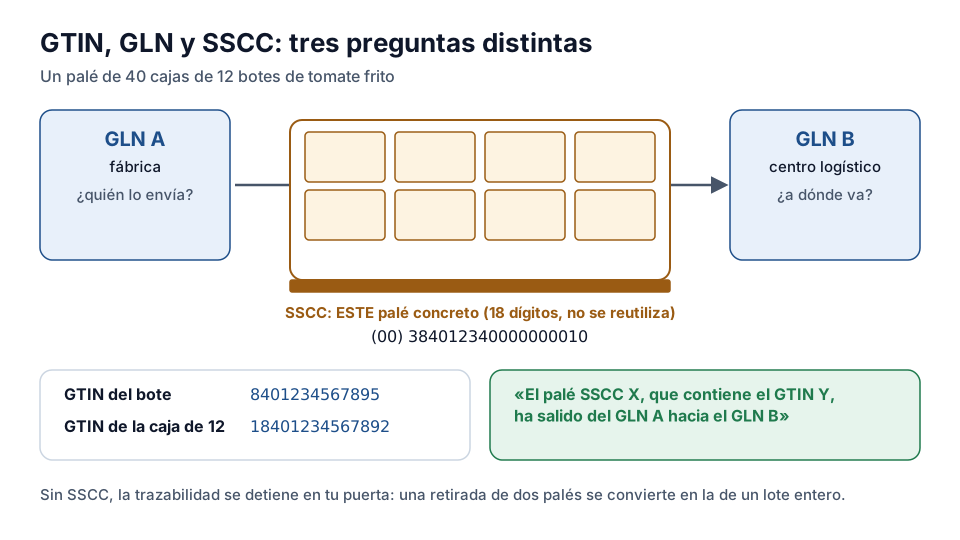
Imagine a pallet with 40 cases of 12 jars of tomato sauce. The GTIN of the jar is the identifier of the trade item “400 g jar of tomato sauce of this brand”; that of the case of 12 is a different GTIN. The SSCC identifies this particular pallet — not “pallets of tomato sauce”, but the one standing at dock 3 — and it is unique and never repeated. The GLN identifies dock 3, the warehouse it belongs to and the company that runs it.
With those three, any movement can be described without ambiguity: “pallet SSCC X, containing GTIN Y, has left GLN A for GLN B”. That is literally the content of a despatch advice.
The SSCC is the key to traceability
The SSCC has 18 digits and is never reused: GS1's recommendation is not to use an SSCC again for at least a year, and in practice systems always generate a new one. That uniqueness is what allows a recall to affect the exact pallets and not a whole day's production.
If a company identifies its units with an internal number instead of an SSCC, its traceability stops at its door: the customer cannot link what it receives with what the supplier sent. That is the failure that turns a recall of two pallets into a recall of an entire batch.
Exercise
GLN and SSCC
What is the GLN (Global Location Number)?
- The GS1 identifier of a location or of a legal and functional entity
- A two-dimensional barcode
- The product's batch number
What is the SSCC?
- The Serial Shipping Container Code, unique for each logistic unit
- The single-use barcode at the point of sale
- The identifier of the electronic invoicing envelope
Related lessons
Reading is free. When you sign up, you also:
- You save your progress and pick up where you left off
- You take the exams, marked straight away
- You receive a completion record, with your name, for each course you finish
- You ask and answer in the Community (in Spanish)
- You get the PRO level by adding your products
- With PRO, you unlock the advanced tools: labels, GS1-128 and SSCC
Unlock PRO tools and completion records Free. The team reviews every application.
Already have access?Mark this lesson as read in My academy
This lesson is part of the course GS1 and Regulatory Labelling, from the Barcode and Traceability Academy.
This module includes the exam “Module 1 exam: GS1 identifiers”.
Next lesson The golden rule: a different product, a different GTIN 9 lessons left in the course