GTIN-13, GTIN-12, GTIN-8 and GTIN-14: when to use each
What a barcode is The GTIN and its variants Lesson 4 of 14
GTIN (Global Trade Item Number) is the generic name of GS1's trade item identifier. There are four official lengths, and the choice depends on the where and the what: GTIN-13 (printed as EAN-13) for retail products in Europe and most of the world; GTIN-12 (UPC-A) in North America; GTIN-8 (EAN-8) for packs so small that the full symbol doesn't fit; and GTIN-14 (ITF-14) for logistic units: cases, packages and levels of grouping.
One logical identifier, several expressions
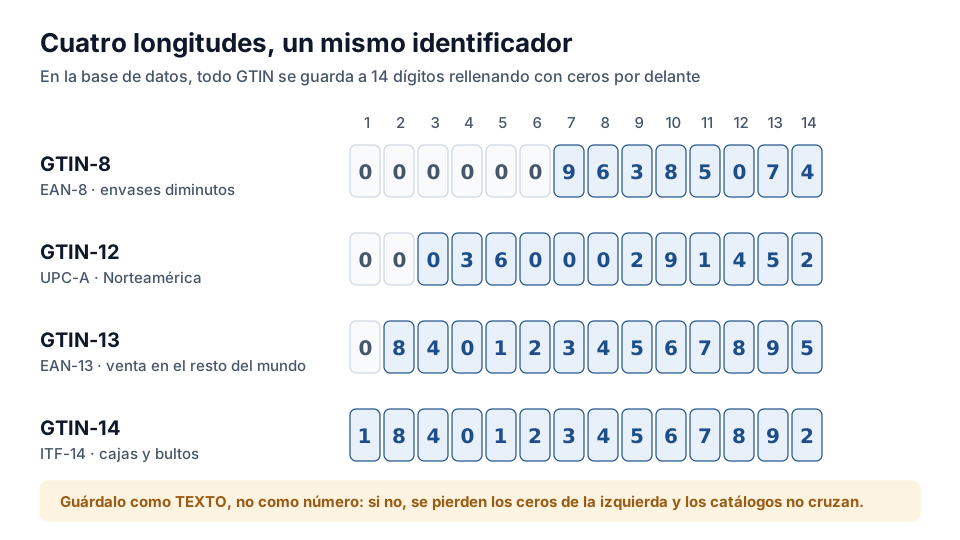
The rule that puts everything in order: the same product has a single logical GTIN even if it is printed at a different length. The standard defines the normalisation: every GTIN is represented internally with 14 digits by adding leading zeros, so that 8412345000010 (GTIN-13) and the 08412345000010 stored by a 14-digit system are, for a database, the same item. A GTIN-12 from a UPC-A barcode is completed in the same way, with two leading zeros, and a GTIN-8 with six.
This solves the classic problem of transatlantic trade: the US manufacturer with UPC-A and the European retailer with EAN-13 talk about the same product without conversion tables, because both systems normalise to GTIN-14.
How to choose in practice
If you manufacture consumer goods in Europe, your consumer unit carries a GTIN-13. If a pack is physically unable to hold the full symbol, that particular pack can carry a separately licensed GTIN-8. If you group products for distribution — the case of 12, the mixed pallet — each level of grouping carries a GTIN-14 with its packaging indicator.
And if you are going to sell on marketplaces: all the big ones (Amazon included) check that the GTIN you declare is licensed by GS1 and matches the brand. A malformed or invented GTIN is a direct cause of a product listing being blocked.
The mistake to avoid from day one
Treating the GTIN as an “internal” number that can be recycled or made up. The GTIN is a contract with the global market: it is licensed, allocated once per product and respected throughout the product's commercial life, including its history. On how to allocate it properly without surprises, see the lesson on common mistakes in this same module.
The same number at different lengths
The four formats aren't four systems: they are the same identifier with different padding. A GTIN-12 (the American UPC-A) is a GTIN-13 with a leading zero, and a GTIN-13 is a GTIN-14 with a leading zero. That is why GS1's recommendation for databases is to always store fourteen digits, padding with zeros on the left: that way an item bought in the United States and another bought in Spain can be compared without conversions.
The classic integration mistake is storing the GTIN as a number instead of as text. The leading zero disappears, 0012345678905 becomes 12345678905, and from then on no catalogue match adds up. It is the cause of a surprising share of product set-up incidents.
The GTIN-14 indicator digit
The GTIN-14 adds an indicator digit at the front, from 1 to 8, which distinguishes groupings of the same product: if the consumer unit is 8412345678905, the case of twelve can be 18412345678902 and the pallet 28412345678909: the indicator, the first twelve digits of the unit and a new check digit. Indicator 9 is reserved for variable measure units.
There is a common temptation to avoid: the indicator isn't free. Each combination of product and grouping needs its own GTIN-14, and the check digit is recalculated over the thirteen new digits — it isn't inherited from the GTIN of the consumer unit.
Exercise
Choosing the right GTIN
Which product carries an ITF-14 in the supply chain?
- The consumer unit on the supermarket shelf
- The case or logistic unit that groups selling units
- The price label at the till
Related lessons
Reading is free. When you sign up, you also:
- You save your progress and pick up where you left off
- You take the exams, marked straight away
- You receive a completion record, with your name, for each course you finish
- You ask and answer in the Community (in Spanish)
- You get the PRO level by adding your products
- With PRO, you unlock the advanced tools: labels, GS1-128 and SSCC
Unlock PRO tools and completion records Free. The team reviews every application.
Already have access?Mark this lesson as read in My academy
This lesson is part of the course Barcode and GTIN Fundamentals, from the Barcode and Traceability Academy.
This module includes the exam “Module 1 exam: Fundamentals”.
Next lesson Anatomy of the EAN-13: prefix, company, product and check digit 10 lessons left in the course