ITF-14 on cases and logistic units
Linear symbologies Choosing the right symbology Lesson 14 of 14
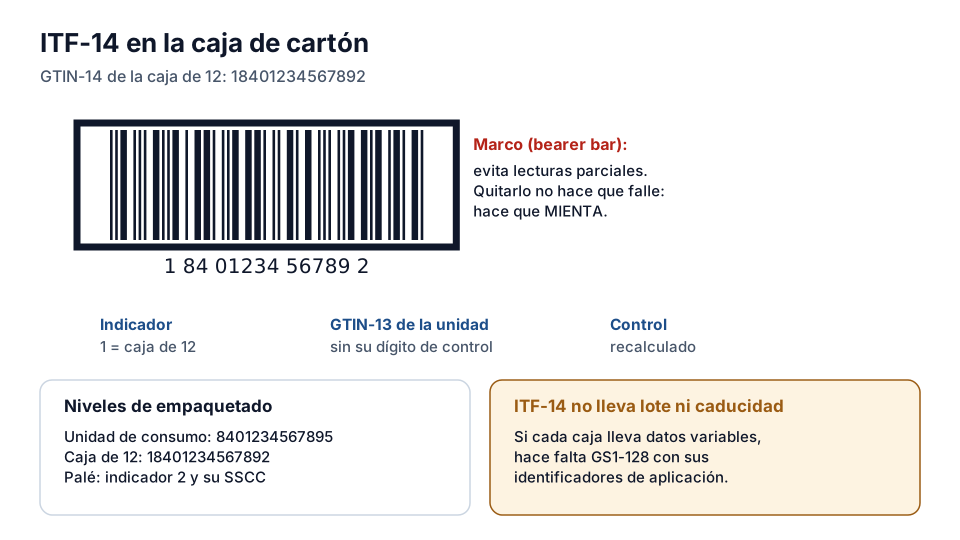
The ITF-14 encodes the GTIN-14: the identifier of the outer case or shipping carton. It begins with the packaging level indicator (1 for the case containing 12 units, 2 for the one with 24, up to 8 for the higher levels), followed by the GTIN-13 of the product contained, with leading zeros, and the check digit recalculated over the fourteen.
Why a different symbology for cardboard
The ITF (Interleaved Two of Five) symbology uses bars and spaces of double width and is printed directly onto corrugated board — that is why its lines are thick and its quiet zone wider. Corrugated board absorbs ink unevenly and distorts the edges; the ITF-14 is designed to tolerate exactly that, where a fine-barred EAN-13 would be unreadable.
Another practical feature: the ITF-14 usually carries the human readable interpretation in large type and, often, the truncated symbol (without the lower guard bars) to reduce the risk of partial reads from low angles — the so-called “window” of the symbol.
The golden rule of logistics
The case's GTIN-14 is different from the GTIN of the single product, and so it should be: the retailer's warehouse scans the complete case on receipt, breaks it down, and scans the individual units when replenishing the shelf. Each packaging level, its own identifier — and if you build mixed pallets, each pallet also carries its SSCC, the logistic serial number you will get to know in depth in the Traceability course.
Where it is printed and what the channel requires
The ITF-14 goes on at least two opposite sides of the case, with the magnification the corrugated board allows (the standard asks for generous magnifications — above 50% of the symbology's nominal size, in practice as large as the case will take). Fast-moving consumer goods customers usually specify in their supplier guides the minimum size, the position and the required verification quality: it is essential reading before designing the packaging, not after.
Why there is a separate symbology
ITF-14 was born for a very specific problem: printing directly onto corrugated board. The surface is rough, the ink spreads and the edges blur. ITF-14 tolerates that imprecision much better than EAN-13 because its bars are wider and because it has a frame — the bearer bar, that thick box around it — which prevents partial reads when the beam enters or leaves from one side.
That frame isn't decorative: if it is removed from the final artwork “because it looks better”, the symbol starts producing short reads that the system accepts as valid. It is one of the most dangerous design mistakes, because it doesn't fail, it lies.
What goes inside and what doesn't
ITF-14 encodes a GTIN-14, that is, the indicator digit plus the GTIN of the consumer unit. And nothing else: no batch, no expiry date, no weight. As soon as the case needs variable data, the right symbology is no longer ITF-14 but GS1-128, which does accept Application Identifiers.
The practical rule for choosing: if the case is always the same, ITF-14 is enough and cheaper to print; if each case carries a different batch or date, you need GS1-128 and a variable label printer. Combining both on the same case is valid and common.
Exercise
The outer case barcode
What is the ITF-14?
- The symbology used for the GTIN-14 on cases and shipping cartons
- A code for identifying yourself on the web
- An electronic invoicing standard
Related lessons
Reading is free. When you sign up, you also:
- You save your progress and pick up where you left off
- You take the exams, marked straight away
- You receive a completion record, with your name, for each course you finish
- You ask and answer in the Community (in Spanish)
- You get the PRO level by adding your products
- With PRO, you unlock the advanced tools: labels, GS1-128 and SSCC
Unlock PRO tools and completion records Free. The team reviews every application.
Already have access?Mark this lesson as read in My academy
This lesson is part of the course Barcode and GTIN Fundamentals, from the Barcode and Traceability Academy.
This module includes the exam “Module 3 exam: Linear symbologies”.
Last lesson of the course. Go over the contents or sign up for free and take the final exam: when you pass it, you get a completion record for the course.