EAN-8 for small packs
Linear symbologies Choosing the right symbology Lesson 13 of 14
The EAN-8 exists because there are packs — single-dose cosmetics, pencils, matches, jewellery tags, chewing gum packets — where an EAN-13 doesn't fit with its full quiet zone. It has eight digits: prefix, short product reference and check digit. The principle is identical; the space it needs, half.
They aren't allocated like EAN-13s
EAN-8s don't derive from your company prefix: GS1 licenses them from dedicated ranges, precisely so that short numbers don't collide with anyone else's. If your company needs EAN-8s, they are requested from your national GS1 organisation as a separate block, and managing them (which number goes to which product) is still your responsibility.
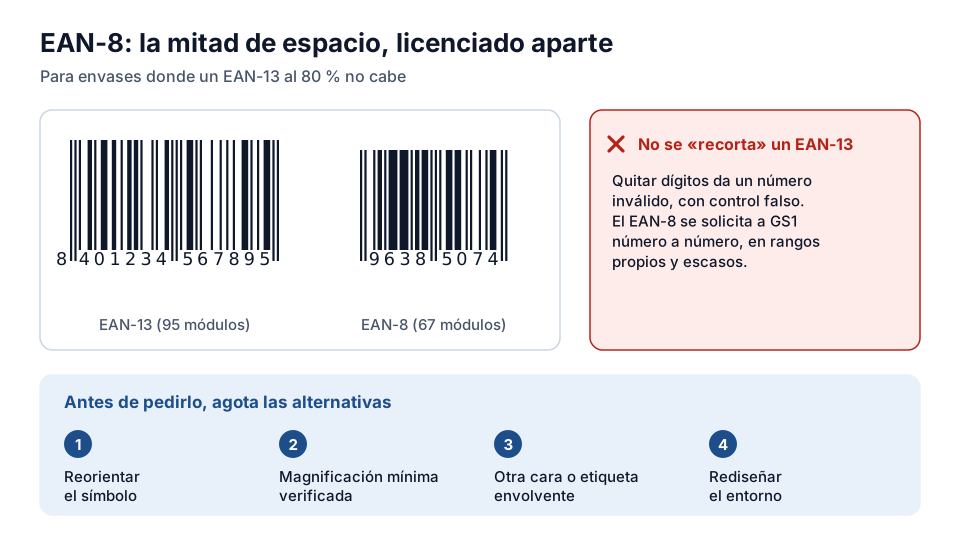
Hence the rule that causes the most mistakes: you can't “compress” your EAN-13 by removing digits. The EAN-8 is an identifier in its own right, different, licensed separately — and a cut-down EAN-13 is an invalid number with a false check digit that the first serious scanner will reject.
Before asking for an EAN-8, exhaust the alternatives
In order of preference: reorient the symbol (vertical, or “ladder” style around the pack), reduce the magnification to the minimum your printing can sustain with A/B verification, redesign the symbol's surroundings to guarantee the quiet zone, and use the symbol with the truncated human readable interpretation that the standard allows in extreme cases. The EAN-8 is the last reasonable resort — and also the first when the pack has less than one square centimetre of usable space.
At the point of sale
The EAN-8 is read at the checkout exactly like the EAN-13: the same type of scanner, the same treatment in the system. It is the product record that tells them apart, and normalisation to GTIN-14 lets it sit smoothly alongside the rest of your catalogue. The only thing it doesn't support in practice is the additional data symbol: for batch and expiry date on tiny packs, the modern route is the Data Matrix — the subject of the fourth course.
It isn't a free alternative
EAN-8 isn't “the EAN-13 for when it doesn't fit”: it is a scarce resource. The GS1 organisation grants it case by case, and only when it is shown that the EAN-13 at 80% magnification doesn't fit on the available face. The reason is arithmetic: the EAN-8 numbering space is much smaller and would soon run out if it were handed out on demand.
Before applying for it, it is worth exhausting the alternatives: reducing to the minimum allowed magnification, looking for another face of the pack, using a wrap-around label or rethinking the design. In most cases in which a customer asks for an EAN-8, an EAN-13 fits.
What you lose by using it
A GTIN-8 doesn't carry the company prefix encoded as such, so it isn't derived from the range the company already has: it is applied for individually, number by number. That means you can't plan a family of products in advance, and every new item requires an application.
In the database it is stored like any other GTIN: padded to fourteen digits with leading zeros. Treating it as “a short code” and storing it with eight is the source of half the catalogue matching problems with small products.
Exercise
When to use EAN-8
What is the EAN-8 used for?
- For very small products where the EAN-13 doesn't fit
- For pallets and logistic units
- For invoices and administrative documents
Related lessons
Reading is free. When you sign up, you also:
- You save your progress and pick up where you left off
- You take the exams, marked straight away
- You receive a completion record, with your name, for each course you finish
- You ask and answer in the Community (in Spanish)
- You get the PRO level by adding your products
- With PRO, you unlock the advanced tools: labels, GS1-128 and SSCC
Unlock PRO tools and completion records Free. The team reviews every application.
Already have access?Mark this lesson as read in My academy
This lesson is part of the course Barcode and GTIN Fundamentals, from the Barcode and Traceability Academy.
This module includes the exam “Module 3 exam: Linear symbologies”.
Next lesson ITF-14 on cases and logistic units 1 lesson left in the course