EAN-13 and UPC-A in retail
Linear symbologies Choosing the right symbology Lesson 12 of 14
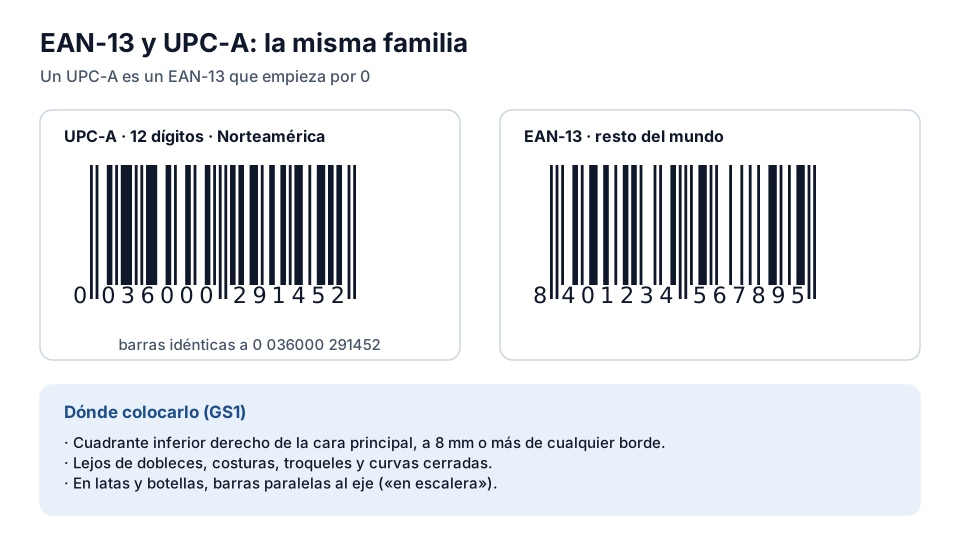
EAN-13 and UPC-A are the same family: the 12-digit North American UPC-A is functionally an EAN-13 with a 0 in front. Modern systems treat them as equivalent and normalise both to GTIN-13 (or to 14, in logistics). If your product is sold on both sides of the Atlantic, a single GTIN-13 is usually enough — UPC scanners have read EAN-13 without any special configuration for years.
The European point-of-sale symbol
In Europe the EAN-13 is the default point-of-sale symbol: it is printed on the pack, the checkout reads it and the system resolves the price, the item record, VAT and active promotions. If your product goes into large retail, this is the symbol the buyer will require on the pack, together with the master data record that backs it up.
Design rules that avoid 90% of incidents
First: magnification within range — the standard recommends 100% as the starting point, with 80% as the floor only for genuinely small packs and with guaranteed verification. Second: placement — a flat area of the pack, away from curves, seals, die cuts and the pack's opening line; the symbol on a tin is aligned with the axis of the can so that the scanner can read it “ladder” style if needed. Third: a legible human readable interpretation (the digits under the bars) — it is your safety net when the symbol fails.
Fourth, the one that most surprises newcomers: commission the printing as what it is — a regulated component. Your printer must give you verifiable samples and keep up quality control for each print run. “The ink drifted on us” is grounds for a formal incident report, not an acceptable excuse.
Can you print it yourself, in short runs?
Yes, with judgement: thermal or thermal transfer label printers print flawless EAN-13s for short runs, as long as the magnification respects the resolution of the print head (203 dpi allows 100% with room to spare; for small magnifications, 300 dpi). Verify the first label of each batch and the system will stand up to any audit.
Coexistence without conversion
UPC-A is the historical standard of North America and EAN-13 that of the rest of the world, but since 2005 every retail scanner accepts both: a UPC-A is an EAN-13 whose first digit is zero. The consequence for a Spanish company exporting to the United States is reassuring: no different barcode is needed; the same GTIN is valid in both regions.
What you do need to check is the size of the pack and the final artwork, because UPC-A takes up slightly less space and many American designs leave just enough room for it. And you need to check the customer's catalogue: some old systems still store twelve digits and truncate the thirteenth.
Where to place the symbol
GS1's guidelines place it at the bottom of the back of the pack, preferably on the right, and not on the base; if possible, between 8 and 100 mm from any edge, and always avoiding corners, folds, joins and bag seams. On cylindrical packs less than 12 cm in diameter it goes “ladder” style: with the bars horizontal, one above the other, so that the curvature doesn't distort them.
Placing it in an area that folds is the most common mistake on flexible bags: the symbol passes verification when flat and fails in the shop, which is exactly the scenario internal controls should have anticipated.
Exercise
Retail symbologies
Which symbology is typically used on retail items in Europe?
- EAN-13 (or UPC-A in North America)
- Code 39
- MSI
What is the main difference between UPC-A and EAN-13?
- UPC-A has 12 digits and EAN-13 has 13
- UPC-A is two-dimensional and EAN-13 is linear
- There is no difference: they are the same standard
Related lessons
Reading is free. When you sign up, you also:
- You save your progress and pick up where you left off
- You take the exams, marked straight away
- You receive a completion record, with your name, for each course you finish
- You ask and answer in the Community (in Spanish)
- You get the PRO level by adding your products
- With PRO, you unlock the advanced tools: labels, GS1-128 and SSCC
Unlock PRO tools and completion records Free. The team reviews every application.
Already have access?Mark this lesson as read in My academy
This lesson is part of the course Barcode and GTIN Fundamentals, from the Barcode and Traceability Academy.
This module includes the exam “Module 3 exam: Linear symbologies”.
Next lesson EAN-8 for small packs 2 lessons left in the course