Symbol verification: what a verifier measures
Scanning in the real world Print quality Lesson 11 of 14
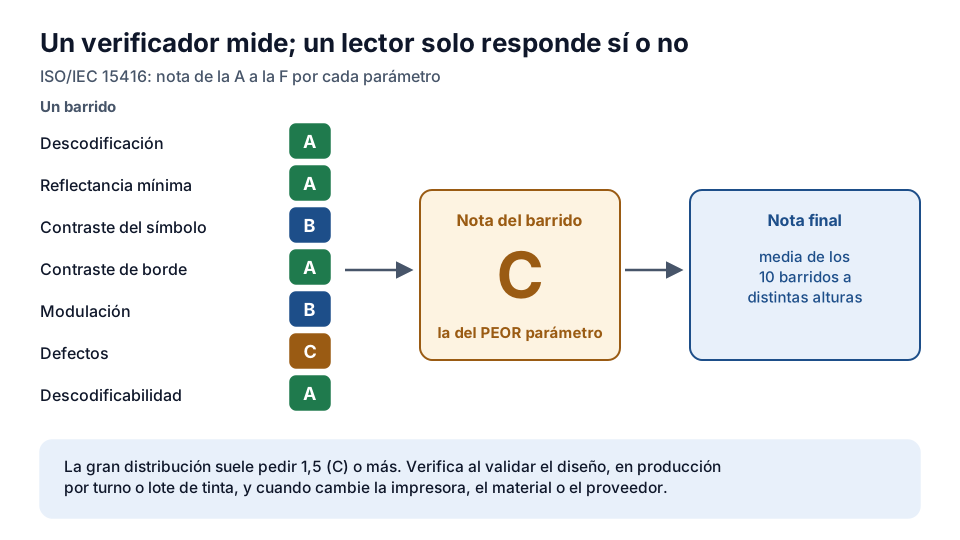
A barcode verifier isn't an expensive scanner: it is a calibrated measuring instrument. Where the scanner answers the yes-or-no question “do I read it or not?”, the verifier measures standardised parameters of the symbol and gives each one a grade from A to F: decode, minimum reflectance, symbol contrast (EC), edge transitions, modulation, defects and, for linear symbols, the width ratio and decodability.
How it is measured, in one paragraph
The device illuminates the symbol with standardised light (660 nm in linear practice), scans it with an aperture defined by the magnification, and analyses the reflectance profile: how dark the bars are, how white the spaces are, how sharp the transitions are, how faithful the widths are to the nominal. ISO/IEC 15416 defines the method for linear symbols; ISO/IEC 15415 does the same for 2D symbols, with lighting from several directions.
Why the overall grade is the most demanding
Each scan of the verifier gets the grade of its worst parameter, and the overall grade of the symbol is the average of those scans: ten, spread across the height of the barcode, according to ISO/IEC 15416. A faded strip lowers the grade of the scans that cross it and drags the average down. This is deliberate — in production, the customer's scanner can pass over any part of the symbol, so no section can be bad.
When and how to verify
At three moments: when validating a new label design (with the real production machine, ink and material), periodically during production (per shift or per change of ink batch, depending on volume), and whenever something changes — a new printer, new material, a new label supplier. The verification report is the document a large customer will ask you for during supplier approval; keep them filed by date.
For those starting out: a compliant portable verifier is enough for medium volumes, and there are batch verification services if the investment doesn't fit yet. What isn't optional is the standard you set: demanding grade A (or B as a negotiated minimum) for your own symbols is what separates a professional supplier from one that “prints barcodes”.
A verifier is not the same as a scanner
A scanner answers yes or no. A verifier measures, according to a standard, and returns a grade from A to F (or from 4.0 to 0.0) with details of which parameter brought it down. The difference matters because a symbol can read today in your warehouse with your scanner and fail tomorrow at your customer's checkout: the scanner doesn't warn you that the symbol was borderline; the verifier does.
The verifier also imposes controlled conditions — aperture, wavelength, angle — that the scanner in the field doesn't have. That is why its results are comparable between factories and admissible in a claim against a supplier; a scanner's are not.
The parameters that are measured
In linear symbology (ISO/IEC 15416) the measurements include symbol contrast, modulation, minimum reflectance, defects, decodability and minimum edge contrast. The final grade of each scan is that of the worst parameter, not the average — a detail that explains why a symbol with everything right except one isolated defect can end up at C.
The grade usually required by large retailers is 1.5 (C) or higher for the symbol on the pack, and 1.5 in logistics. Signing a contract without setting the required grade and the measurement method is a classic source of conflict when the rejections arrive.
Resources
Exercise
Quality verification
What does a barcode verifier do?
- It charges for the product at the checkout
- It measures the quality of the symbol and gives it a grade (A/B/C/F)
- It translates the GTIN into the product's name
Related lessons
Reading is free. When you sign up, you also:
- You save your progress and pick up where you left off
- You take the exams, marked straight away
- You receive a completion record, with your name, for each course you finish
- You ask and answer in the Community (in Spanish)
- You get the PRO level by adding your products
- With PRO, you unlock the advanced tools: labels, GS1-128 and SSCC
Unlock PRO tools and completion records Free. The team reviews every application.
Already have access?Mark this lesson as read in My academy
This lesson is part of the course Barcode and GTIN Fundamentals, from the Barcode and Traceability Academy.
This module includes the exam “Module 2 exam: Scanning and quality”.
Next lesson EAN-13 and UPC-A in retail 3 lessons left in the course