Setting up labelling quality control in your factory
Labelling and regulations Quality and verification Lesson 12 of 12
Labelling quality control has three layers, and it works when all three exist. First: design validation — before printing the first pack of an item, verify the final symbol with the real production machine, ink and material, and keep the report as the design's starting reference.
Second layer: in-line control
Periodic visual check (quiet zone, contrast, position, legible human readable interpretation) and full verification per shift or per change of ink batch, depending on volume. The reasonable minimum sampling on an average line: at the start of the shift, after each significant stoppage, and every two hours. Each sample is verified and filed with its report — the file is the evidence an auditor or a customer asks for.
Third layer: statistical control
Record the grades and watch the trend. A symbol that goes from A to B in three weeks is announcing a worn print head, an out-of-specification ink or an unannounced change of material — and the chart gives it away before your customer's checkout does. The trend is more valuable than the one-off value: quality declines gradually and is cheap to correct if detected early.
The minimum equipment for your volume
Medium volumes: a compliant portable verifier (with the correct aperture for your magnifications) and a one-page written procedure. Continuous production: in-line verifiers that automatically reject labels below the threshold. In both cases the documented procedure — who measures, when, with what criteria, what happens if it fails — is as important as the device: it is what turns the investment into a system, not an appliance.
The indicator that sums up the system
The customer's first pass read rate (when the channel shares it) or, failing that, your percentage of A/B verifications. A single figure at the monthly meeting, with its trend, captures the whole system: validated design, in-line control and statistics. If the figure is healthy, everything else is working; if it moves, the system tells you where to look first.
The three control points
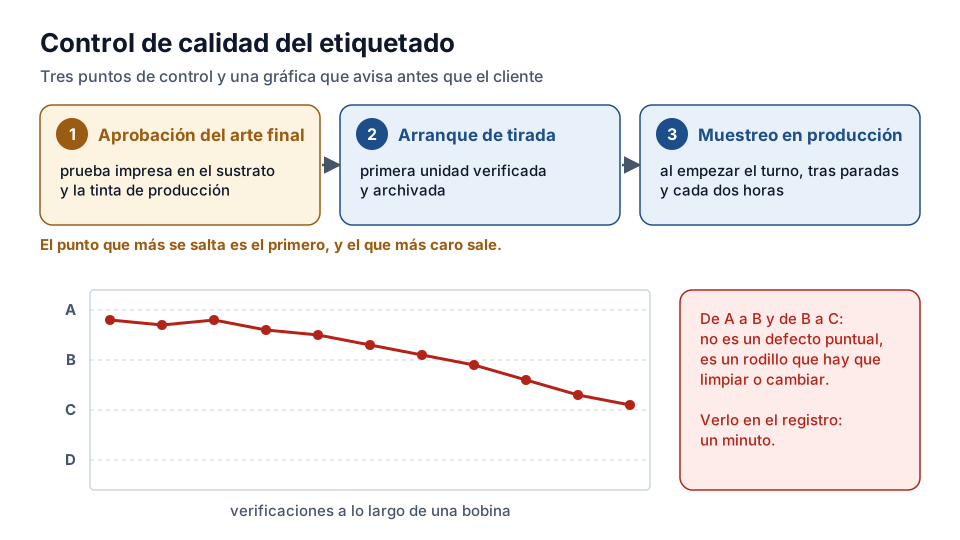
A control system that works rests on three moments. Approval of the final artwork, before printing anything: a printed proof on the same substrate and with the same ink as production is verified — not a PDF or an office printout. Start of the print run: the first unit verified and filed. Sampling during production: one unit every so many, with the frequency adjusted to that item's history.
The point most often skipped is the first, and it is the most expensive: final artwork with an invaded quiet zone produces a hundred thousand defective packs before anyone notices.
What to record and why
For each verification, record the date, the item, the batch, the grade obtained, the measurement settings and the verifier's report. That record serves three different purposes: demonstrating due diligence to a customer who rejects goods, detecting a machine's drift before it produces a failure, and negotiating with the printer on the basis of data instead of impressions.
Drift is the most profitable finding: a symbol that drops from A to B and from B to C over a reel isn't a one-off defect; it is a roller that needs cleaning or replacing. Seeing it in the record takes a minute; finding out through a customer rejection costs a lorryload.
Exercise
Quality control in the factory
How often should symbols be verified in labelling quality control?
- Only when a customer complains
- Periodically and in a planned way: each new design, each change of material and by sampling during production
- Just once, when the printer is installed
Related lessons
Reading is free. When you sign up, you also:
- You save your progress and pick up where you left off
- You take the exams, marked straight away
- You receive a completion record, with your name, for each course you finish
- You ask and answer in the Community (in Spanish)
- You get the PRO level by adding your products
- With PRO, you unlock the advanced tools: labels, GS1-128 and SSCC
Unlock PRO tools and completion records Free. The team reviews every application.
Already have access?Mark this lesson as read in My academy
This lesson is part of the course GS1 and Regulatory Labelling, from the Barcode and Traceability Academy.
This module includes the exam “Module 3 exam: Labelling and regulations”.
Last lesson of the course. Go over the contents or sign up for free and take the final exam: when you pass it, you get a completion record for the course.