The golden rule: a different product, a different GTIN
Governing identifiers Allocating and maintaining GTINs Lesson 4 of 12
GS1's rule for allocating a new GTIN fits in one sentence: a new GTIN when something changes that the customer, the channel or the regulations treat as a different product. A new flavour, a different net quantity, a different declared formula, a different main brand or a version of the pack only in another language: new GTIN. It is the most quoted allocation rule in the standard — and the one SMEs break most often.
When a new GTIN is NOT allocated
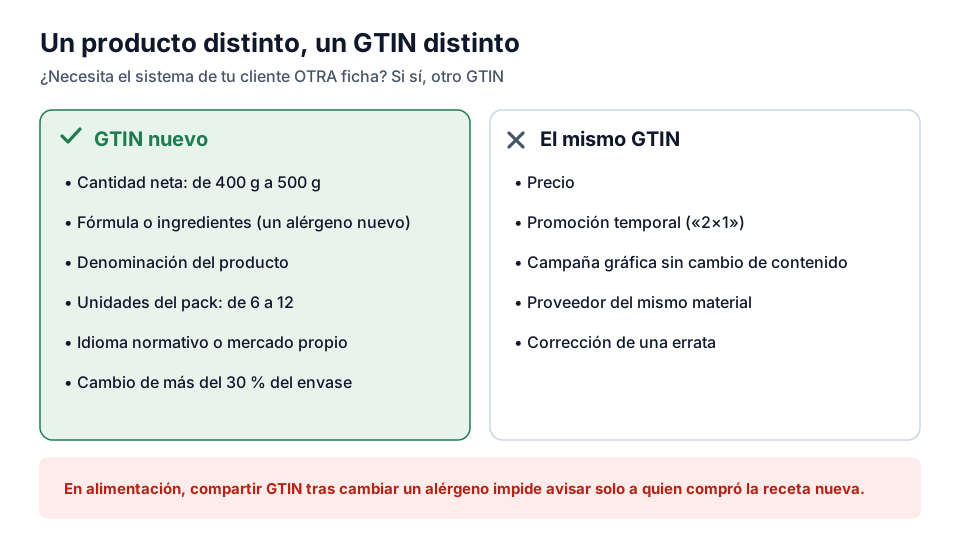
It isn't allocated when what changes doesn't alter the identity of the item: the selling price in the shop's systems, a till promotion (“2 for 1”), the supplier of the same material or cosmetic corrections to the pack. Nor when the pack starts advertising a feature the product already had and didn't declare (rule 2 of the standard). The promotion is managed in the retailer's system; the design, in your master data record. Giving a new GTIN for this fragments the product's sales history at the customer.
Watch out for the printed price
The price the shop charges doesn't change the GTIN, but the one printed on the pack itself does: adding it, changing it (from €3 to €2) or removing it requires a new GTIN (rule 10). GS1 advises against printing it, because the price on the pack may end up being different from the one charged at the till.
The borderline cases teams argue about
A limited-edition pack with the same contents, such as a Christmas design or a championship logo? The selling unit keeps its GTIN, but its cases and pallets get a new one to tell them apart in the supply chain (rule 7). A change of selling format (from 6 units to 12)? New GTIN, always: the declared quantity changes (rule 3). The same product with a new allergen in the recipe? New GTIN: what the label must declare by law changes, and the consumer has to be able to tell it apart (rule 2). A version of the pack only in Portuguese? The standard gives an identical case, with another language, among its examples of a new product: new GTIN (rule 1).
The practical test that decides everything
Picture the product record in your retail customer's system. Does it need to be another record — another description, another weight, another photo, another slot on the shelf — or is it enough to update the existing one? If the record is a different one, the GTIN is a different one. It is the same question the principles of the standard ask: whether the customer or the channel has to tell the product apart, whether the law requires the change to be disclosed, or whether the way it is transported, stored or received changes.
And when in doubt, ask the channel before printing: buyers and the chains' supplier guides resolve these cases every day. A twenty-line email costs less than relabelling twenty thousand units.
The triggers in the standard
GS1's standard for managing the GTIN (GTIN Management Standard) lists the changes that require a new GTIN: a new product, a different declared formula or functionality, a different declared net quantity (from 400 g to 500 g), a change of more than 20% in a dimension or in the gross weight, adding or removing a certification mark on the pack, a different main brand, a different number of units in the pack or in the case, and a printed price on the pack that is added, changed or removed. Each country's rules may require more.
A change of design only, without touching any of the above, isn't among those reasons. And a seasonal promotional edition (a seasonal pack, a gift attached without changing the contents) doesn't change the GTIN of the selling unit, but it does change that of its cases and pallets, to tell them apart in the supply chain.
Real cases, with the standard's examples
The standard comes with examples for each rule. These are the ones closest to what happens in a food factory or a small food business:
A bag of snacks goes from 680 g to 794 g. The declared net quantity changes: new GTIN for the bag and for its cases (rule 3). It makes no difference whether the quantity goes up or down.
Salmon that was sold frozen starts being sold fresh. What is declared about the product changes: new GTIN (rule 2). The same goes for a recipe that halves the sugar so that it can say “low in sugar”, or one that adds tree nuts, an allergen the consumer has to be able to tell apart.
The pack changes from plastic to glass and the gross weight goes up from 0.34 to 0.68 kg. That is a change of more than 20% in the gross weight: new GTIN (rule 4). Chaining small changes so as never to exceed 20% is, according to the standard, an unacceptable practice.
The pack stops carrying the organic logo. Adding or removing a certification mark — organic, halal, kosher — requires a new GTIN (rule 5).
The case goes from 9 to 12 units. The product doesn't change, so neither does its GTIN; the case's does (rule 8). The same with a pallet that goes from 12 to 16 cases.
A wine changes vintage and consumers recognise it as being of different quality. If it isn't replenished without distinguishing vintages but is sold as a product in its own right, it gets a new GTIN (rule 1).
What happens when the rule is broken
Two different products with the same GTIN break everything that relies on the identifier: the sales history mixes two items, demand forecasting is calculated on false data, stock doesn't add up and — most serious of all — a recall can't be narrowed down, because there is no way to tell in the system which units are of the old formula.
In food this stops being a data problem and becomes a safety problem: if the new formula includes an allergen and shares a GTIN with the old one, there is no way to warn only those who bought the new one.
Exercise
When a new GTIN is allocated
When must a new GTIN be allocated?
- When something changes that the customer, the channel or the regulations treat as a different product
- With each production run
- Every time the selling price changes
Related lessons
Reading is free. When you sign up, you also:
- You save your progress and pick up where you left off
- You take the exams, marked straight away
- You receive a completion record, with your name, for each course you finish
- You ask and answer in the Community (in Spanish)
- You get the PRO level by adding your products
- With PRO, you unlock the advanced tools: labels, GS1-128 and SSCC
Unlock PRO tools and completion records Free. The team reviews every application.
Already have access?Mark this lesson as read in My academy
This lesson is part of the course GS1 and Regulatory Labelling, from the Barcode and Traceability Academy.
This module includes the exam “Module 2 exam: Governance and AIs”.
Next lesson Synchronising data with customers (GDSN) 8 lessons left in the course