Common GTIN allocation mistakes and how to avoid them
What a barcode is The GTIN and its variants Lesson 6 of 14
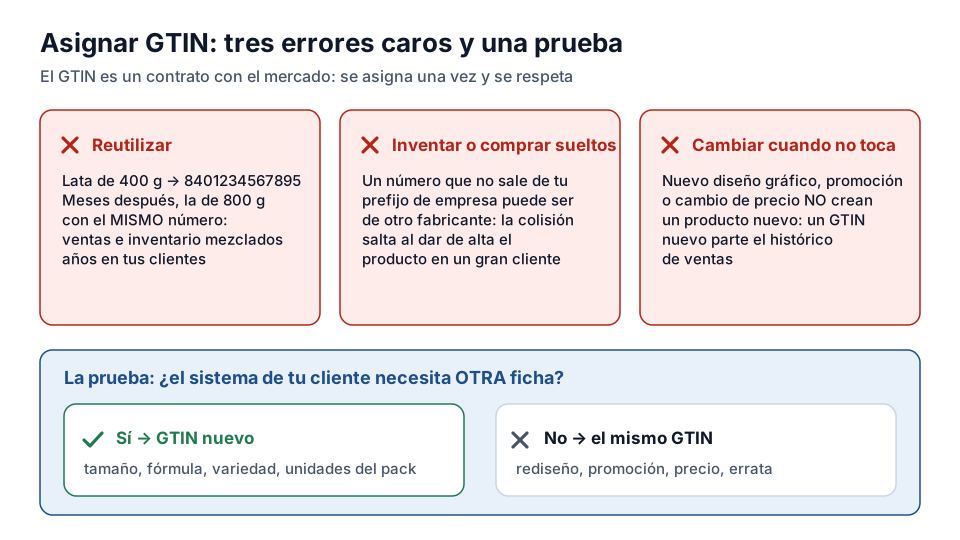
The most expensive mistake in the sector: reusing a GTIN. If the code 8412345000010 was the 400 g tin of tomatoes and months later you stamp it on the 800 g tin, your customers' systems will mix up the sales, stock and records of both products for years. History is sacred: a GTIN identifies a product throughout its commercial life, and it remains “that product's” even after it is withdrawn, because statistics and quality traces will keep citing it.
The three cardinal sins of allocation
First, reusing — already covered: it contaminates the product's history across the whole channel. Second, inventing “provisional” numbers: an invented GTIN can coincide with that of another company somewhere in the world, and the collision blows up in the worst possible place — a marketplace shop window or a large customer's warehouse. Third, changing the GTIN when you shouldn't: changing the price, launching a temporary promotion, changing the graphic design or changing the supplier of the same material don't create a new product, and giving them a new GTIN fragments the sales history at the customer.
The golden rule and its practical test
Allocate a new GTIN when something changes that the customer, the channel or the regulations treat as a different product: size, formula, variety, consumer unit, the regulatory language of the pack, a country of sale with its own labelling. And don't allocate one when what changes doesn't alter the identity of the item.
The mental test we recommend: picture the product record in your customer's system. Does it need to be another record — another description, another weight, another photo, another EAN on the shelf — or is it enough to update the existing one? If the record is a different one, the GTIN is a different one. This same rule, fully developed, is the heart of the Governance module of the GS1 course.
How to make it watertight in your organisation
Give ownership of the GTIN catalogue to a single role (a person, not a committee), with a central register — however basic the spreadsheet — where each GTIN is entered with its record, its date and its status. 90% of duplicate incidents happen in companies where “each department allocates them as best it can”.
When you have to change the GTIN
The million-dollar question in any company that launches products. GS1's rule is one of commercial sense: if the buyer — consumer or trade — notices the change and needs to tell it apart, a new GTIN is needed. In practice that includes any change to the declared net quantity, the formula or the ingredients, the main brand, a certification announced on the pack or the number of units in a pack, and any change of more than 20% in a dimension or in the gross weight.
On the other hand, it isn't required by a graphic redesign that alters none of the above, a printed promotion that doesn't change the contents or the correction of a typo. Reasonable doubt is resolved by the general principle: if two items cannot be substituted for each other without anyone noticing, they are different items and need different identifiers.
The three most expensive mistakes
Reusing a withdrawn GTIN too soon. GS1 generally asks you to wait forty-eight months from the last shipment before reassigning a number to another product, and in food the recommendation is never to reuse it. Doing it sooner makes catalogues, sales histories and traceability systems mix up two different items under the same identifier.
Using the same GTIN for the pack and for the unit. If the single unit is sold, it needs its own; the six-pack needs its own. Sharing it makes it impossible to reconcile stock and throws out what is charged at the till.
Making up numbers or buying them individually from a third party. A GTIN that doesn't come from the company prefix assigned by a GS1 organisation can collide with another manufacturer's. The collision isn't discovered on the day it is printed, but on the day a large retailer tries to set up the product and its system replies that the number already exists.
Exercise
Governing the GTIN catalogue
What is considered the most serious mistake when allocating GTINs?
- Reusing a GTIN already allocated to another product
- Starting the numbering with a low number
- Using a spreadsheet for the catalogue
Related lessons
Reading is free. When you sign up, you also:
- You save your progress and pick up where you left off
- You take the exams, marked straight away
- You receive a completion record, with your name, for each course you finish
- You ask and answer in the Community (in Spanish)
- You get the PRO level by adding your products
- With PRO, you unlock the advanced tools: labels, GS1-128 and SSCC
Unlock PRO tools and completion records Free. The team reviews every application.
Already have access?Mark this lesson as read in My academy
This lesson is part of the course Barcode and GTIN Fundamentals, from the Barcode and Traceability Academy.
This module includes the exam “Module 1 exam: Fundamentals”.
Next lesson How a scanner works: laser and imaging 8 lessons left in the course