The essential AIs: batch (10), expiry (17) and serial (21)
Governing identifiers Application Identifiers (AI) Lesson 8 of 12
AI (10) identifies the batch or lot: the traceability data item par excellence in food, pharmaceuticals and cosmetics. It is alphanumeric and of variable length, which allows batch schemes that people can read (“L2609A”, “2026-09-A”) without giving anything up for machines. Everything the Traceability course builds — surgical recalls, mock recalls, exact scope — rests on this field.
Expiry: AI (17)
AI (17) expresses the expiry date, in YYMMDD format; the best-before date has its own AI, (15), with the same format. Together with the batch, the expiry date forms the inseparable pair of FEFO (First Expired, First Out) management in the warehouse: the retailer's system reads the expiry date and orders dispatch without opening a single case. In regulatory labelling, the date printed for the consumer and the one encoded in the symbol must always match — a discrepancy is an immediate quality incident.
The serial number: AI (21)
AI (21) adds the serial number of the individual unit. The difference from the batch is one of granularity: the batch tells you “these 5,000 units came out together”; the serial number tells you “this particular unit, number 4,213”. It is the basis of unit-level traceability — mandatory in pharmaceuticals under European serialisation, and valuable in fine food, consumer electronics and anti-counterfeiting.
The full trio: what it means operationally
GTIN + batch + expiry (+ serial number where applicable) is the typical content of a modern traceability 2D code: with that data, the same symbol serves to charge at the till (GTIN), manage stock rotation (expiry) and carry out a recall (batch). In the 2D Codes course you will see how they are put together in a Data Matrix, how much space they need and what printing them on a production line requires.
A content rule worth establishing: each item of data that goes into the symbol must have a real use — everyone uses batch and expiry; only those who work by unit use the serial number. More data isn't more traceability: it is more print space used and more room for error.
What each one contributes to traceability
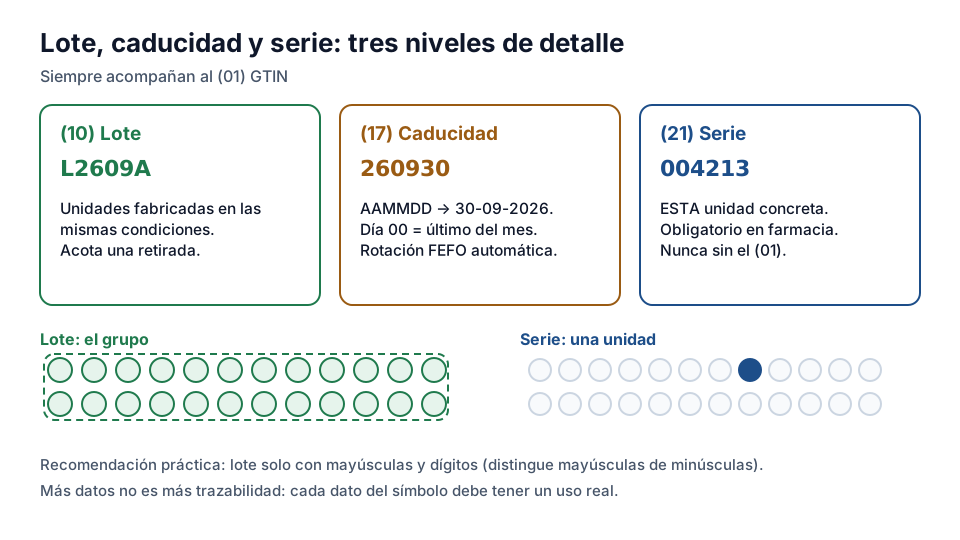
The (10) batch is what allows a recall to be narrowed down: it identifies a set of units made under the same conditions. The (17) expiry date travels in YYMMDD format and allows automatic rotation and the blocking of expired goods at receipt. The (21) serial number individualises the unit, and is what turns batch traceability into unit traceability — mandatory for medicines and growing in high-value products.
Combined with (01) they form the typical logistic label: which product it is, from which batch, until when and, where applicable, which one exactly.
Details that cause problems
The batch is case-sensitive and allows characters that not all systems treat the same way: the practical recommendation is to stick to capital letters and digits. In the date, the day `00` is valid and means “last day of the month”, a convention that surprises more than one programmer and has to be allowed for when validating.
And a warning about (21): it isn't used on its own; it always goes with (01). A serial number without the GTIN it belongs to identifies nothing, because two manufacturers can issue the same serial number.
Exercise
Batch and expiry AIs
Which AI identifies the expiry date?
- AI (17)
- AI (01)
- AI (10)
Which AI identifies the batch number?
- AI (10)
- AI (21)
- AI (00)
Related lessons
Reading is free. When you sign up, you also:
- You save your progress and pick up where you left off
- You take the exams, marked straight away
- You receive a completion record, with your name, for each course you finish
- You ask and answer in the Community (in Spanish)
- You get the PRO level by adding your products
- With PRO, you unlock the advanced tools: labels, GS1-128 and SSCC
Unlock PRO tools and completion records Free. The team reviews every application.
Already have access?Mark this lesson as read in My academy
This lesson is part of the course GS1 and Regulatory Labelling, from the Barcode and Traceability Academy.
This module includes the exam “Module 2 exam: Governance and AIs”.
Next lesson Food labelling in the EU: Regulation 1169/2011 4 lessons left in the course