Food labelling in the EU: Regulation 1169/2011
Labelling and regulations Labelling obligations Lesson 9 of 12
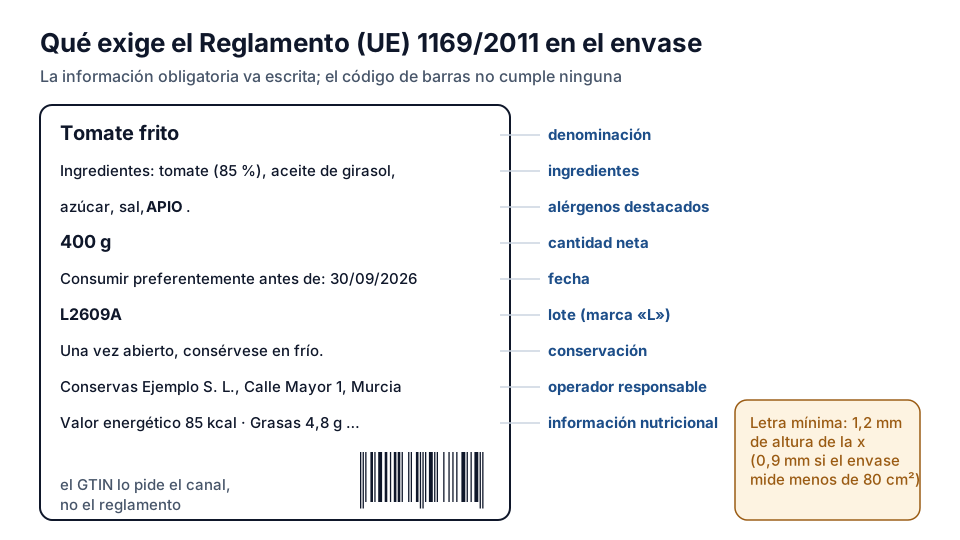
Regulation (EU) No 1169/2011 defines the mandatory food information on packaging: the name of the food, the list of ingredients with allergens emphasised, the net quantity, the date of minimum durability or the use-by date, storage conditions and/or conditions of use, the responsible company or operator, the origin where applicable, and the nutrition declaration. It is the framework regulation for food labelling throughout the EU, developed by sector-specific regulations.
What concerns this course: batch and traceability
What matters here: labelling and traceability are distinct and complementary obligations. Regulation 1169/2011 requires the date of minimum durability or the use-by date to be shown on the pack; the batch is required by another rule, Directive 2011/91/EU, under which every food must be accompanied by an indication identifying its batch, generally preceded by the letter “L”. And Regulation (EC) No 178/2002, the General Food Law, requires traceability to be ensured at every stage of the chain in its Article 18. A label without a batch breaches Directive 2011/91/EU and, on top of that, breaks the traceability chain the law requires of all operators downstream.
And an operational consequence that is often forgotten: the batch printed on the pack must match exactly the batch recorded in your shipping documents. If the pack says L2609 and the delivery note says 2609-A, the customer who receives a complaint won't be able to match the two records — traceability breaks because of an inconsistency in writing, not for lack of a system.
Allergens: the zero-tolerance part
The fourteen allergens that must be declared are emphasised typographically in the list of ingredients (bold, italics, colour…) — and modern systems also encode them in the master data you synchronise via GDSN, because the online channel needs to declare them with the same precision as the physical label. A wrongly declared allergen is the most serious labelling incident: it is a direct cause of a recall and of a RASFF notification.
How it all fits with the barcode
Regulation 1169/2011 doesn't require a GTIN — but the channel does. The professional food label carries, on one side, the regulatory information for the consumer (1169) and, on the other, the GS1 symbol with the GTIN and, if the channel's traceability makes use of it, the 2D code with batch and expiry. Regulation and standard don't compete: the regulation says what must be disclosed; the standard, how it is identified and moved along the chain.
What it requires, specifically
Regulation (EU) No 1169/2011 on the provision of food information to consumers sets the mandatory particulars: the name of the food, the list of ingredients, allergens emphasised typographically within the list, the quantity of certain ingredients, the net quantity, the date of minimum durability or the use-by date, storage conditions, the details of the responsible operator, the country of origin where applicable, instructions for use, the alcoholic strength and nutrition information.
It also sets a minimum font size: an x-height of 1.2 mm for normal packs and 0.9 mm for surfaces smaller than 80 cm². It isn't design advice; it is a requirement that can be checked in an inspection.
What the barcode does NOT solve
It is worth saying clearly because it is the misunderstanding that straddles both worlds: no obligation under Regulation 1169/2011 is met by printing a barcode. The mandatory information has to be on the pack, legible to the naked eye, in the language of the country where it is sold.
What the identifier does provide is consistency: that the electronic record the manufacturer publishes via GDSN says exactly the same as the pack. Discrepancies between pack and record are a frequent source of penalties, and they almost always arise from a formula change that was updated in one place and not the other — which is, once again, the problem of GTIN allocation.
Exercise
Food labelling regulations
Which labelling obligation applies to food in the EU?
- Regulation 1169/2011 on the provision of food information to consumers
- The ISO 9001 quality standard
- The REACH Regulation on chemical substances
Related lessons
Reading is free. When you sign up, you also:
- You save your progress and pick up where you left off
- You take the exams, marked straight away
- You receive a completion record, with your name, for each course you finish
- You ask and answer in the Community (in Spanish)
- You get the PRO level by adding your products
- With PRO, you unlock the advanced tools: labels, GS1-128 and SSCC
Unlock PRO tools and completion records Free. The team reviews every application.
Already have access?Mark this lesson as read in My academy
This lesson is part of the course GS1 and Regulatory Labelling, from the Barcode and Traceability Academy.
This module includes the exam “Module 3 exam: Labelling and regulations”.
Next lesson Is a barcode mandatory? The law versus the market 3 lessons left in the course