First pass reads: why they matter
Scanning in the real world The point of sale Lesson 8 of 14
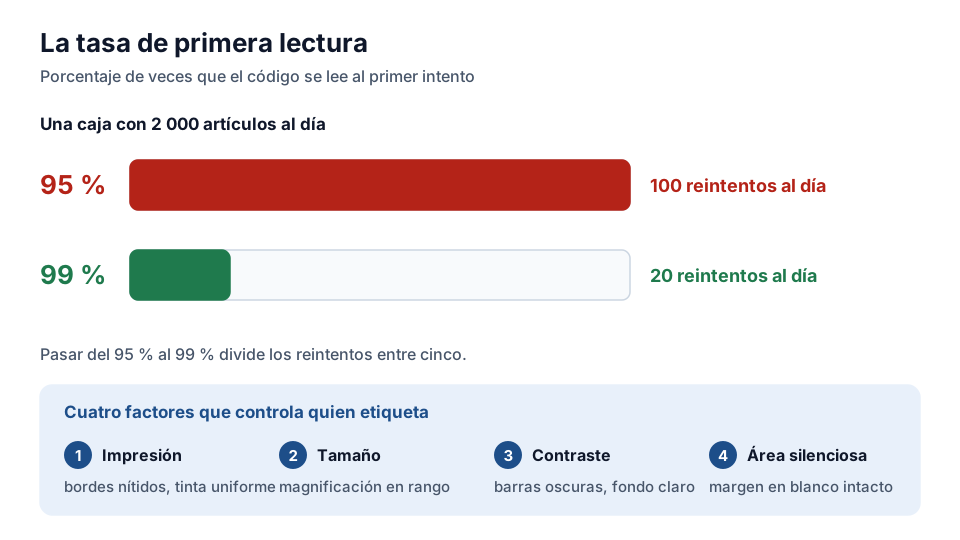
The first pass read rate (First Pass Reading Rate) is the percentage of times the symbol is decoded correctly at the first attempt. It is the metric that large retailers obsess over, and with good reason: every retry adds seconds to every line at every checkout. With thousands of transactions a day and dozens of checkouts, the difference between 95% and 99% of first pass reads translates into longer queues, more staff hours and more incidents per shift.
How the channel measures its suppliers
Retail chains measure this rate by supplier and by item, at their real checkouts. A supplier with poor first pass reads receives formal incident reports; in the worst case, their labels are reprinted in the customer's warehouse at their expense, or the product is taken off the shelf for “operational problems”. It is one of the few technical metrics that can end up being a commercial one.
The four factors that determine it
The good news: the rate almost always depends on four controllable factors. One, print quality — sharp edges, even ink, suitable material. Two, the right symbol size — magnification within the range the symbology allows and your printer can handle well. Three, contrast — bars that absorb the scanner's light on a background that reflects it. Four, an intact quiet zone — the margin that lets the scanner know where the symbol starts and ends.
None of the four is expensive. All of them are checked with well-designed quality control of the labelling — which is the final lesson of this module and, in full, the close of the GS1 course.
The sector's golden rule
Before approving a label design, print a sample with the real production machine and material, read it twenty times with a scanner like the customer's and verify its quality. A verifier gives an objective grade; twenty consecutive reads without a failure give operational confidence. The two together take an afternoon and save relabelling campaigns.
What is really measured
The first pass read rate is the percentage of attempts resolved without repeating the pass. It isn't a laboratory indicator: it is the one the cashier notices, the one that lengthens the queues and the one that decides whether an automated warehouse needs a person watching the sorting line.
A difference that looks small isn't. Going from 95% to 99% means dividing retries by five: at a checkout with two thousand items a day, that is a hundred incidents a day against twenty. On a sorting belt with ten thousand packages, eighty rejected packages against four hundred.
The three usual causes
When first pass reads drop, in the vast majority of cases the cause is one of these three: the quiet zone invaded by text or a design border, insufficient contrast — light ink on a light background, or the classic mistake of printing in red, which many scanners can't tell from white — and distortion of the symbol when the pack stretches, typical of shrink film and flexible bags.
The fourth cause, less frequent but harder to diagnose, is gloss: a varnish or a reflective plastic sends the scanner's beam straight back to the sensor and saturates it. It is solved with a matt finish in the area of the symbol, not by changing scanners.
Exercise
First pass read rate
What is the first pass read rate (First Pass Reading Rate)?
- The percentage of times a barcode is scanned correctly at the first attempt
- The time it takes the till to open
- The number of products per second a checkout reads
Related lessons
Reading is free. When you sign up, you also:
- You save your progress and pick up where you left off
- You take the exams, marked straight away
- You receive a completion record, with your name, for each course you finish
- You ask and answer in the Community (in Spanish)
- You get the PRO level by adding your products
- With PRO, you unlock the advanced tools: labels, GS1-128 and SSCC
Unlock PRO tools and completion records Free. The team reviews every application.
Already have access?Mark this lesson as read in My academy
This lesson is part of the course Barcode and GTIN Fundamentals, from the Barcode and Traceability Academy.
This module includes the exam “Module 2 exam: Scanning and quality”.
Next lesson What happens when a barcode fails to scan 6 lessons left in the course